
Why can some people get instant coverage while others still need a nurse visit?
Why can some people get instant coverage while others still need a nurse visit? This analysis explains underwriting triage, data checks, and why some cases still fall out of the fast lane.
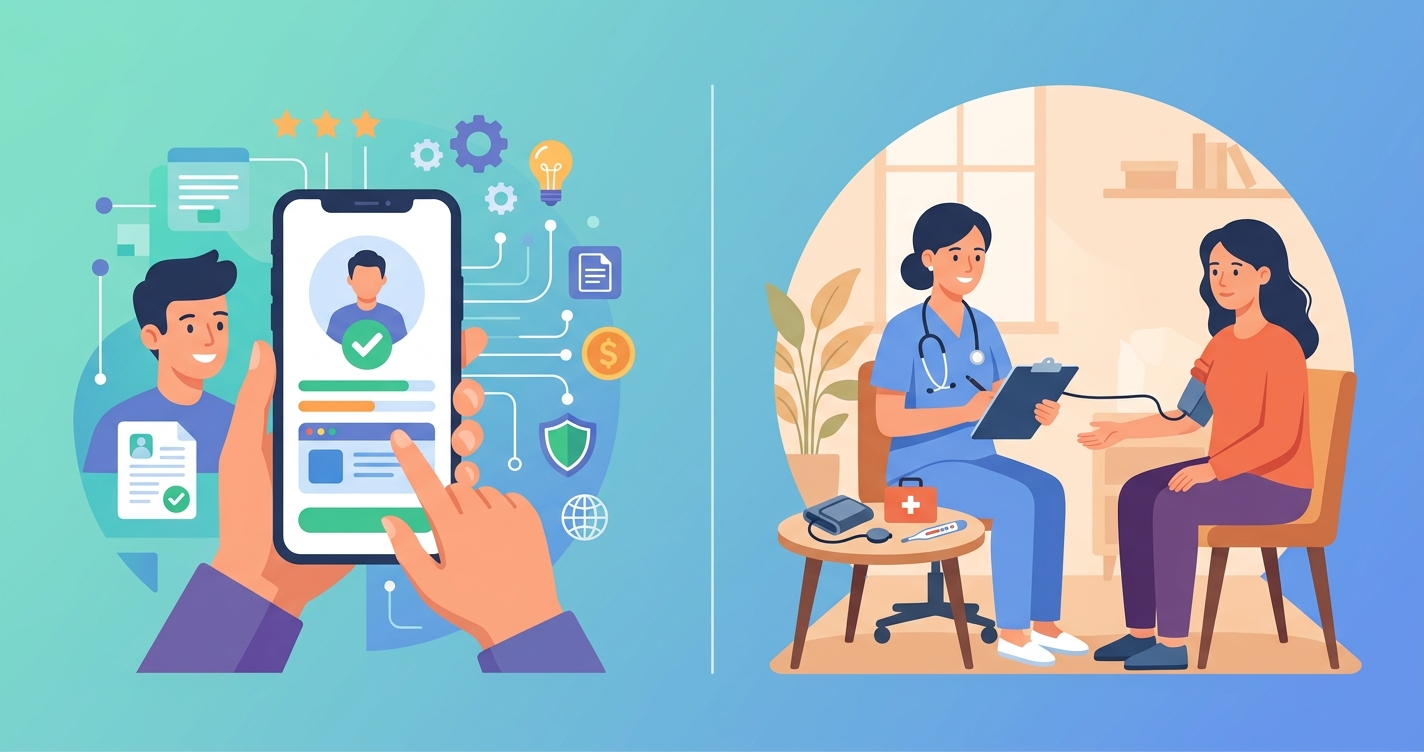
If two people apply for life insurance on the same afternoon, one may get an instant answer while the other gets asked to schedule a nurse visit. That feels arbitrary from the outside. It usually is not. The difference comes down to how much confidence the carrier has in the file after the first round of digital evidence comes back. If the applicant's age, face amount, prescription history, identity checks, disclosures, and third-party records line up cleanly, the case can stay in accelerated underwriting. If they do not, the carrier starts asking for more proof.
Gen Re's 2025 U.S. Individual Life Next Gen Underwriting Survey found that 59% of individual life applications qualified for an accelerated path, while only 12% reached fully automated decisioning. That gap is the whole story. Fast coverage is common enough to market, but still narrow enough to be selective.
Why instant coverage and nurse visits exist in the same market
The easy consumer version is that some carriers are modern and some are old-fashioned. I do not think that is really it.
A nurse visit shows up when the carrier decides the digital evidence is not strong enough on its own. That could happen because of age, requested coverage amount, medication history, an incomplete electronic record, or a mismatch between what the applicant said and what outside data suggests.
Instant coverage, on the other hand, is really a routing outcome. The carrier is saying the file looks clean enough to price without fluids, labs, or a paramed exam. That does not mean no underwriting happened. It means the underwriting happened through data calls instead of a nurse with a blood-pressure cuff.
What usually separates the instant lane from the nurse-visit lane
Carriers draw this boundary in slightly different places, but the same signals keep showing up.
- Lower or moderate face amounts are easier to accelerate than very large policies.
- Younger and middle-age applicants are more likely to fit carrier acceleration rules.
- Straightforward prescription histories are easier to automate.
- Clean matches across application answers, identity tools, MIB records, and other databases keep the file moving.
- Cases with missing, conflicting, or borderline evidence tend to get kicked to traditional review.
That last point matters most. A person can be reasonably healthy and still end up with a nurse visit because the file looks messy, not because the person looks uninsurable.
Comparison table: why one applicant gets instant coverage and another gets a nurse visit
| Scenario | Typical evidence available at triage | Likely path | Why the carrier routes it that way |
|---|---|---|---|
| Moderate face amount, younger applicant, clean Rx and MIB | Application data, identity checks, Rx history, MIB, MVR, sometimes EHR | Instant or same-day accelerated decision | The file is easy to classify with enough confidence |
| Similar applicant but one or two conflicting data points | Application data plus a mismatch in disclosures, address history, or medical signals | Referred for manual review | The carrier needs a human to resolve uncertainty |
| Older applicant or larger face amount | Same digital sources, but higher baseline mortality and financial exposure | More likely to require nurse visit or fuller underwriting | The cost of misclassification is higher |
| Applicant with complex medications or specialist care | Rx history and outside data suggest a more complicated health picture | Nurse visit, labs, APS, or other added evidence | Digital screening alone may not be enough to price the case safely |
That is why instant coverage is not really a reward for being healthy. It is a reward for being easy to classify.
What carriers are checking before they decide you need a nurse visit
This part is invisible to most shoppers, which is why the process can feel random.
Prescription history
Prescription data gives carriers a quick read on treated conditions. Sometimes the application sounds simple but the medication history says otherwise. A cholesterol medication alone may not matter much. A cluster of cardiac, diabetic, or autoimmune prescriptions usually changes the routing decision.
MIB and prior-insurance consistency
MIB helps carriers compare the current application with coded information from prior insurance workflows. If the disclosures line up, acceleration is easier to defend. If they do not, the file can be referred almost immediately.
Age and face amount
Even clean applicants can miss the instant lane because the policy is too large or the issue age is outside the carrier's comfortable acceleration band. This is less about fairness than risk control.
Electronic health records
Electronic health records are becoming more important because they let carriers verify disclosures faster. Munich Re reported that, in a 525-application study, adding EHRs increased immediate decision rates from 68% to 79% and reduced risk-assessment costs by 35%. Better evidence keeps more people out of the nurse-visit queue.
Why some people still get a nurse visit even when they feel healthy
This is the frustrating part.
Applicants usually judge themselves by how they feel. Carriers judge the file by how much uncertainty is left after the first evidence sweep. Those are not the same thing.
A healthy person can still get pushed to a nurse visit because of:
- a larger requested face amount
- an older issue age
- medication patterns that imply follow-up questions
- incomplete or conflicting digital records
- recent specialist visits
- product rules that are narrower than the consumer expected
I keep coming back to the same point: accelerated underwriting is really a confidence system. The carrier is not only asking whether you look low-risk. It is asking whether the available evidence is strong enough to let the case move without collecting fluids.
Industry applications: why carriers try to avoid unnecessary nurse visits
Consumers hate extra friction, but the carrier case is just as important.
Faster placement
LIMRA has reported that traditional underwriting often takes around 27 to 28 days for a final decision, compared with roughly 9 days for accelerated programs. That timing gap affects placement because every extra delay gives the applicant time to disappear.
Better use of underwriting staff
When clean cases move through automated or semi-automated triage, underwriters can spend more time on files that actually need judgment. That is one reason carriers keep widening acceleration where they can do it safely.
More disciplined triage
A nurse visit is expensive and slow. Carriers do not want to order one if a file can be classified with digital evidence. But they also do not want to skip it when uncertainty is high. The whole game is finding the line between those two mistakes.
If you want the operational version of that tradeoff, Full Underwriting vs Accelerated Underwriting: When to Use Each Path is a useful companion. For the shopper view, Can life insurers really approve me in minutes? covers the same issue from the approval side.
Current research and evidence
The public research base here is stronger than it was a few years ago.
Gen Re's 2025 survey is useful because it shows both how mainstream and how limited fast underwriting still is. A majority of applications can qualify for accelerated underwriting, but only a small minority reaches fully automated decisioning. That is why the market can honestly advertise speed while still sending many applicants to follow-up requirements.
Munich Re's mortality slippage work by Lisa Seeman and Katy Herzog is another reason carriers stay cautious. Their 2024 analysis reported average slippage in the 10% to 15% range, with higher trends in some demographic and face-amount segments. That helps explain why a carrier might look at two seemingly simple files and route them differently.
The EHR evidence matters too. If better digital records can raise immediate decision rates, then more applicants can avoid nurse visits without the carrier relaxing standards. That is probably where a lot of the market's next gains will come from.
LIMRA's timing data rounds out the picture. The value of acceleration is obvious when the alternative takes weeks. Carriers do not need every case to be instant. They just need fewer easy cases getting stuck in an old evidence workflow.
The future of instant coverage versus nurse visits
I do not think nurse visits disappear. High face amounts, older applicants, and more complicated medical histories will keep needing deeper evidence.
What changes is the size of that bucket.
As carriers get better at pulling EHRs, reconciling digital records, and layering in fresh biometric signals, more borderline cases may stay out of the nurse-visit path. That is where solutions like Circadify fit into the conversation. The appeal is simple: give underwriting teams more current evidence without rebuilding the old fluid-heavy process.
For shoppers, the practical answer is not very glamorous. Some people get instant coverage because their files are easy to trust. Others still get a nurse visit because the carrier wants more certainty before it prices the risk.
Frequently Asked Questions
Why would two similar applicants get different underwriting paths?
Because carriers are not only comparing health status. They are comparing age, face amount, data consistency, product rules, prescription history, and how much uncertainty remains after digital screening.
Does a nurse visit mean I am likely to be declined?
No. It often means the carrier wants more evidence before making a decision. Many applicants who leave the accelerated lane are still approved after fuller underwriting.
Can a healthy person still miss instant coverage?
Yes. A healthy applicant can still be routed to a nurse visit if the policy amount is high, the digital records are thin, or the file contains details that do not line up cleanly.
Will better digital data reduce nurse visits over time?
Probably. That is already part of the industry's direction. Better electronic health records, stronger identity tools, and newer biometric signals can keep more cases in accelerated underwriting when the evidence is reliable.
If your team is trying to reduce unnecessary nurse visits without weakening risk selection, Circadify's insurance solutions show where fluidless underwriting workflows are heading.