
Should I trust insurance that's underwritten by AI instead of a human?
As insurers adopt AI for underwriting, consumers wonder if they can trust an algorithm over a human. We analyze the data, the research, and what it means for you.
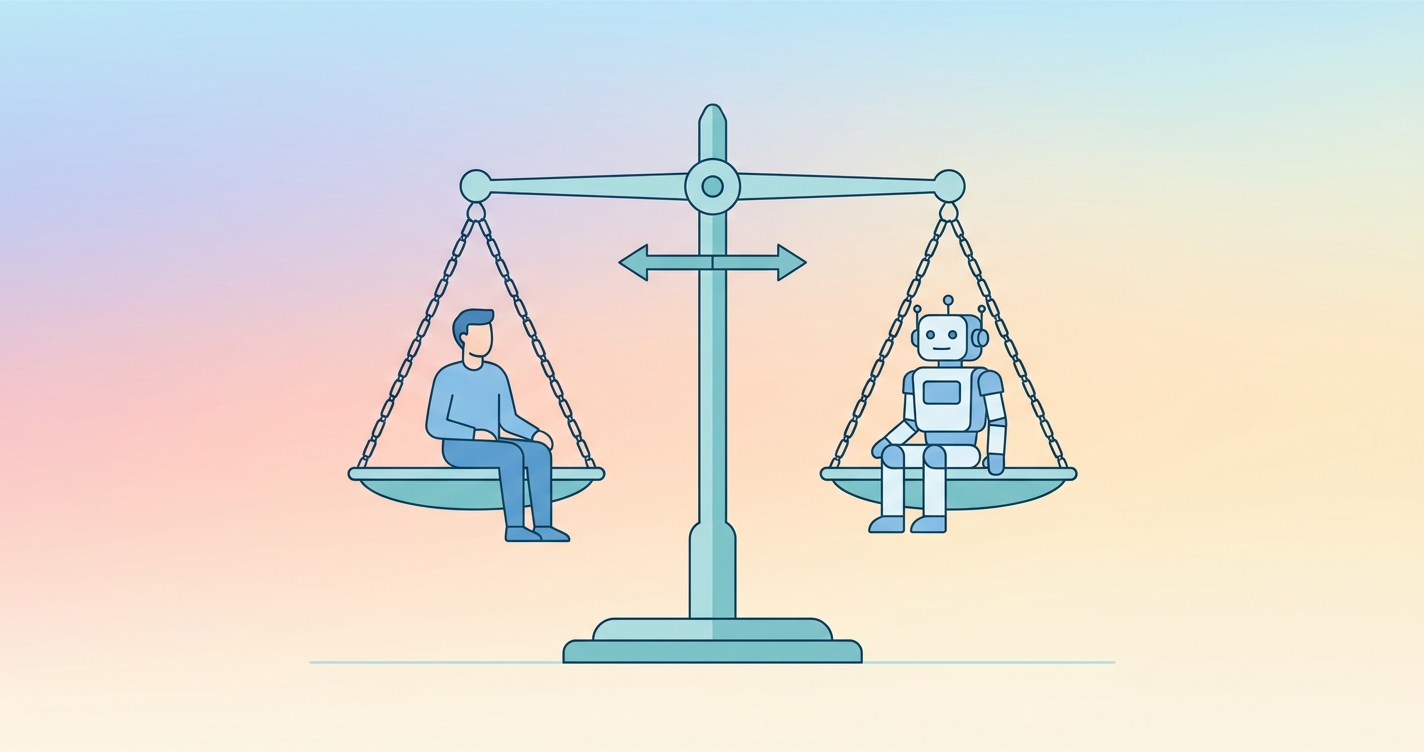
The promise of "instant" life insurance is everywhere. Apply on your phone, get a decision in minutes. This speed is powered by artificial intelligence, which has quietly taken over many of the tasks once performed by human underwriters. For consumers, this raises a direct question: should I trust insurance that's underwritten by AI instead of a human? The answer is complex, balancing the convenience of technology against the deep-seated need for fairness and transparency in a decision as personal as securing your family's future. While consumers are growing more accustomed to AI in daily life, its role in critical financial decisions remains a point of significant friction and skepticism.
"A 2023 survey by global reinsurer Swiss Re found that while consumers are warming to AI, only 41% are comfortable with their insurance provider using AI to calculate prices, and even fewer are comfortable with it being used to determine the outcome of a claim."
- Swiss Re Institute, 2023
AI vs human underwriter trust: an analysis
The core of the AI vs human underwriter trust issue lies in transparency and perceived fairness. A human underwriter can, in theory, look at a case holistically, applying judgment and context. An AI underwriter, on the other hand, follows a rigid set of rules defined in its algorithm. While this is intended to remove subjective bias, consumers worry it can lead to algorithmic bias, where the data used to train the AI contains historical prejudices that result in unfair outcomes for certain demographics.
Research from firms like Cognizant in 2023 shows that consumers are more accepting of AI for routine tasks like status updates but remain wary of its use in core decisions like pricing and claims. Younger generations, like Gen Z, tend to exhibit higher trust in AI, but the overall market remains cautious. A significant portion of consumers feel that the benefits of AI are captured primarily by the insurance company, not shared with the policyholder. Building trust requires insurers to be more transparent about how their AI models work, what data they use, and how they are tested for fairness.
The shift to AI is not happening in a vacuum. It is a response to consumer demand for faster, simpler processes and an industry need to manage costs and improve efficiency. The challenge is to innovate without eroding the fundamental trust that underpins the entire insurance contract.
| Feature | AI Underwriter | Human Underwriter |
|---|---|---|
| Speed | Near-instantaneous decisions possible | Days, weeks, or even months |
| Data Sources | Digital records, health data APIs, questionnaires | Application, medical exams, APS, MIB |
| Consistency | Highly consistent; applies the same logic every time | Variable; subject to individual judgment and bias |
| Transparency | Often a "black box"; reasons for decline can be opaque | Can provide (or be compelled to provide) specific reasons |
| Cost | Lower operational cost per application | Higher operational cost per application |
| Bias | Risk of systemic, algorithmic bias at scale | Risk of individual, subjective bias |
Industry Applications
Insurance carriers are not blind to the trust deficit. The industry is actively exploring ways to make AI underwriting more palatable to consumers and regulators.
Explainable AI (XAI)
One of the most significant pushes is toward "Explainable AI." These are systems designed to articulate the rationale behind their decisions in a way that humans can understand. Instead of a simple "decline," an XAI-powered system could specify which data points led to the adverse decision, such as a particular reading from a lab report or a specific prescription history.
Hybrid Models
Many carriers are not replacing humans entirely but are instead creating hybrid models. In these workflows, AI handles the straightforward, "clean" applications, approving them instantly. Cases that are more complex, borderline, or trigger certain flags are automatically routed to a human underwriter for a final review. This "human-in-the-loop" approach provides a safety net and is often seen as a good compromise.
Third-Party Audits
To build confidence, some technology providers and carriers are engaging third-party firms to audit their algorithms for fairness and bias. The results of these audits can then be used in discussions with regulators and reinsurers to demonstrate a commitment to responsible AI.
Current research and evidence
The academic and industry research on AI vs human underwriter trust is growing rapidly. A 2023 study from the Swiss Re Institute highlighted the consumer skepticism, noting that transparency is a key driver of trust. Their survey found that 66% of consumers would trust an AI application more if they knew a human was supervising the process.
Similarly, research from Benori in 2023 on consumer sentiment in life insurance found that while speed is valued, it does not replace the need for confidence in the outcome. A study by Cognizant pointed out a generational divide, but even tech-savvy consumers expressed discomfort with AI handling their claims, with nearly half (47%) stating they were uncomfortable with the practice. This indicates that even as technology becomes more integrated into our lives, the high stakes of insurance make it a special case. The perception that companies, not consumers, reap the rewards of AI is a major hurdle; one survey noted that 68% of customers believe insurers receive most or all of the benefits.
The Future of AI in Underwriting
The future of underwriting is unlikely to be a pure AI or a pure human model. Instead, it will almost certainly be a more sophisticated hybrid. As AI models become more advanced and transparent, and as consumers get more accustomed to them, some of the current trust issues may recede. However, the fundamental need for recourse and explanation will not disappear. The most successful insurers will be those who use technology to augment, not just replace, human expertise. They will use AI to process the 80% of cases that are standard, freeing up their human underwriters to focus on the 20% that require deep expertise, empathy, and judgment. This allows carriers to achieve efficiency without sacrificing fairness and trust.
Frequently asked questions
Q: If an AI denies my application, will I know why? A: It depends on the insurer and the regulations in your jurisdiction. Many insurers are moving towards providing "adverse action notices" that give a general reason for the decline. However, the level of detail can vary. The push for Explainable AI (XAI) aims to make these reasons much more specific.
Q: Is AI-driven underwriting less biased than human underwriting? A: It has the potential to be, but it's not guaranteed. AI can eliminate the individual, subjective biases of a single human. However, if the data used to train the AI contains historical biases, the AI can perpetuate or even amplify them on a massive scale. Auditing AI models for bias is a critical and ongoing area of work.
Q: Can I request a human review if I'm unhappy with an AI decision? A: Most companies have an appeals process that allows for human review. If you feel a decision was unfair or incorrect, you should always contact the insurer and ask for someone to re-evaluate your file.
As automated systems become more common, companies like Circadify are working on solutions to provide the transparent, verifiable data needed to power the next generation of underwriting tools. By focusing on the quality of the data inputs, the goal is to create a more trustworthy and efficient process for everyone. For more on the actuarial data and frameworks behind modern underwriting, you can find in-depth analysis at circadify.com/industries/payers-insurance.