
Instant Issue Life Insurance Tech: 6 Architecture Patterns That Scale
Six architecture patterns that power scalable instant issue life insurance platforms, from event-driven underwriting to biometric data pipelines.
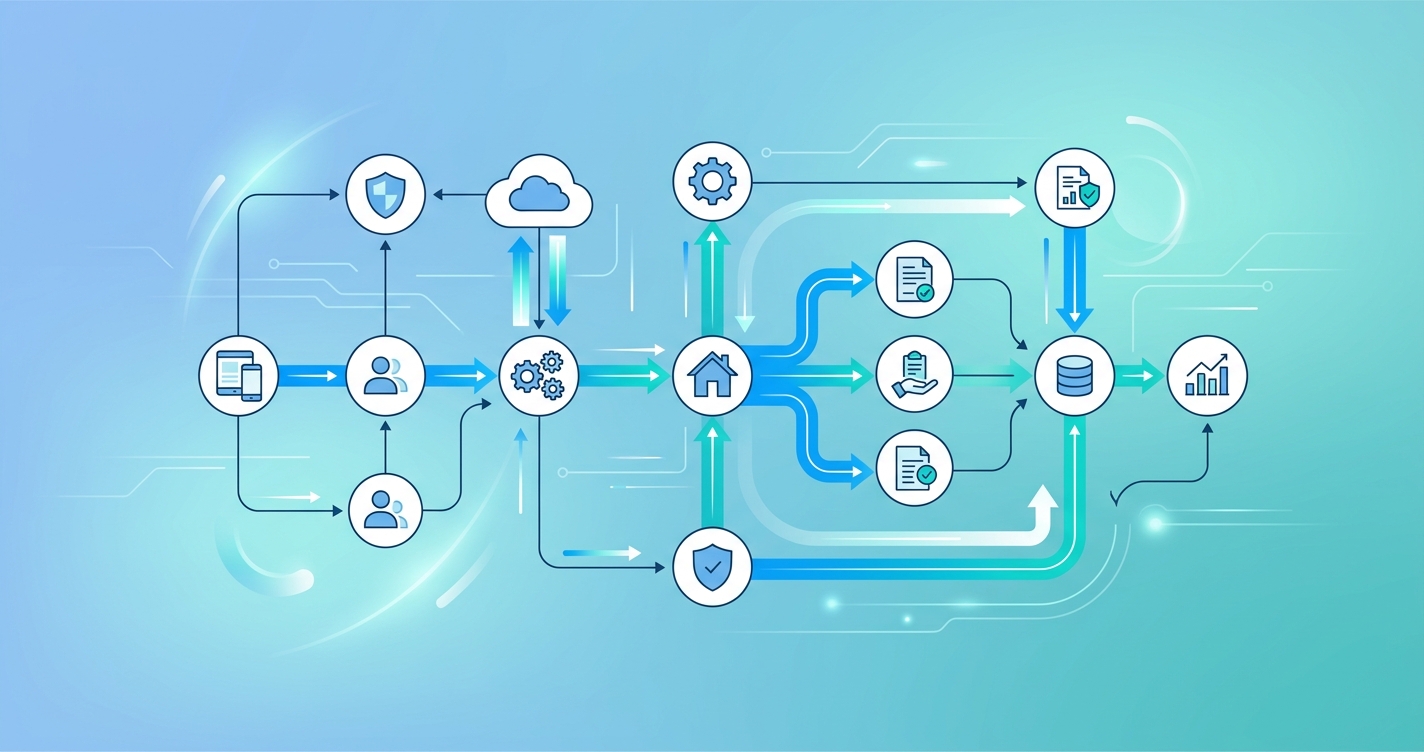
Most instant issue life insurance platforms were built for a simpler time. A short questionnaire, a database lookup, a yes-or-no decision. That worked when face amounts stayed below $50,000 and mortality loads absorbed the risk of thin underwriting. It does not work anymore. Carriers are pushing instant issue into face amounts above $500,000, integrating biometric data streams, and running real-time predictive models against applicant pools that look nothing like they did five years ago. The technology has to keep up, and the old monolithic policy administration systems are buckling under the load.
"The global life insurance market was valued at USD 8.25 trillion in 2025 and is projected to reach USD 19.36 trillion by 2035, growing at an 8.9% CAGR," according to Precedence Research. Instant issue and accelerated programs account for a growing share of new policy volume.
Why Architecture Matters for Instant Issue Life Insurance Tech
The difference between an instant issue platform that handles 200 applications per day and one that handles 20,000 is not just hardware. It is the underlying architecture. Monolithic systems that worked for traditional underwriting—where a case might sit in queue for weeks—fall apart when the expectation is a decision in 90 seconds.
LIMRA reported that U.S. individual life insurance premiums reached $15.9 billion in 2024, with growth continuing into 2025. Much of the new volume is flowing through digital channels that expect real-time responses. When a platform cannot scale, the result is dropped applications, timeouts, and lost policies.
The six patterns below are not theoretical. They are drawn from how current insurtech platforms and modernized carrier systems actually operate.
The 6 Architecture Patterns
1. Event-Driven Underwriting Pipeline
Traditional underwriting systems process applications in batch or through sequential API calls. An event-driven architecture flips this model. Each step in the underwriting process—data ingestion, risk scoring, decisioning, policy issuance—becomes an independent service that reacts to events rather than waiting for upstream processes to complete.
AWS published a reference architecture for event-driven insurance policy processing that decomposes the lifecycle into loosely coupled microservices communicating through event streams. The advantage for instant issue is parallelism: a biometric data capture event can trigger risk scoring, third-party data pulls, and fraud checks simultaneously rather than sequentially.
In practice, this means a 30-second rPPG scan completing on an applicant's phone can fire events to a prescription database lookup, an MIB query, and a mortality model—all at the same time. The decisioning engine collects results as they arrive and makes its call when sufficient data is present, without waiting for the slowest data source to respond.
2. Microservices With Domain Boundaries
Breaking an underwriting platform into microservices is not new advice. But the specific way you draw service boundaries matters enormously for instant issue.
A 2023 paper published in the World Journal of Advanced Research and Reviews by researchers studying AI-driven insurtech platforms found that decomposing insurance functions into containerized microservices—policy issuance, risk scoring, claims triage, fraud detection—orchestrated through Kubernetes allowed independent scaling of high-demand services without affecting the rest of the platform. The risk scoring service, for example, can scale to 50 instances during open enrollment while the claims service stays at baseline capacity.
The domain boundaries that work best for instant issue are:
| Service Domain | Responsibility | Scaling Profile | Failure Mode |
|---|---|---|---|
| Application intake | Capture applicant data, validate fields | Scales with traffic volume | Reject malformed submissions, queue retries |
| Data enrichment | Pull third-party records (Rx, MIB, MVR) | Scales with vendor API throughput | Graceful degradation if vendor is down |
| Biometric capture | Process rPPG or wearable data streams | Scales with concurrent applicants | Timeout and offer manual fallback |
| Risk scoring | Run predictive models on assembled data | Scales with model complexity | Return conservative default score |
| Decisioning | Apply carrier rules to risk scores | Low compute, high availability | Fail closed (route to human review) |
| Policy issuance | Generate policy documents, collect payment | Scales with approval volume | Queue for retry, confirm asynchronously |
The failure mode column is where most platforms get into trouble. When you cannot issue a policy because your Rx vendor is having a bad day, the architecture needs to know what to do about it without bringing down the entire pipeline.
3. CQRS for Underwriting State Management
Command Query Responsibility Segregation (CQRS) separates the write path (accepting applications, updating risk scores, recording decisions) from the read path (checking application status, pulling analytics, generating reports). For instant issue platforms, this separation solves a real problem: the transactional load of processing thousands of concurrent applications should not compete with the analytical queries that actuarial teams and compliance officers run against the same data.
In a CQRS setup, the underwriting command model processes each application through the pipeline and writes events to a persistent store. A separate read model—often a denormalized projection optimized for queries—serves the dashboard views, reporting, and API responses. The write side can be optimized for throughput and consistency. The read side can be optimized for speed and flexibility.
This pattern becomes especially relevant when carriers want real-time underwriting analytics. How many applications are currently in the pipeline? What is the average decision time today? What percentage are being routed to human review? With CQRS, these questions get answered without putting load on the system that is actually making underwriting decisions.
4. Saga Pattern for Multi-Step Underwriting Transactions
An instant issue decision involves coordinating multiple services that each have their own failure modes and timing characteristics. The saga pattern manages this coordination without requiring a distributed transaction that locks resources across services.
Here is the problem it solves: an applicant completes a biometric scan, the platform pulls prescription data, runs a mortality model, and generates a risk score. If the payment processing step fails after the policy has been approved, the system needs to compensate—reversing the approval and notifying the applicant—without corrupting the state of any upstream service.
In an orchestrated saga, a central coordinator manages the sequence and handles compensating actions when any step fails. In a choreographed saga, each service publishes events and other services react accordingly. The orchestrated approach tends to work better for underwriting because the business logic for handling failures (when do you route to a human underwriter versus retrying versus declining) is complex enough that centralizing it makes the system easier to reason about.
5. Biometric Data Pipeline Architecture
This is the pattern that separates modern instant issue from the simplified-issue products of 2018. When a platform ingests real physiological data—heart rate, heart rate variability, respiratory rate, blood pressure estimates from rPPG—it needs a pipeline architecture that can handle streaming data, validate signal quality, extract features, and feed them to models in near real time.
A 2025 review in Frontiers in Digital Health documented that rPPG can extract multiple vital signs from a standard smartphone camera. The challenge is not whether the technology works. The challenge is building an architecture that processes these signals reliably at scale.
The pipeline typically looks like this:
Signal capture layer. The mobile SDK on the applicant's device captures raw video frames and performs initial signal extraction. Edge processing reduces bandwidth requirements and latency.
Quality validation layer. Not every scan produces usable data. Motion artifacts, poor lighting, and camera quality all affect signal integrity. This layer scores signal quality and decides whether to accept the data, request a rescan, or fall back to an alternative assessment.
Feature extraction layer. Raw vital sign signals are processed into features that underwriting models can consume. Heart rate variability metrics, blood pressure trend indicators, respiratory pattern classifications.
Model inference layer. Extracted features feed into risk scoring models alongside traditional underwriting data. This layer needs to handle model versioning, A/B testing of new models, and fallback to older model versions if a new deployment exhibits problems.
Audit and compliance layer. Every data point, every model decision, every score must be logged for regulatory review. This layer cannot be an afterthought—reinsurers and regulators will audit it.
6. API Gateway With Adaptive Rate Limiting
An instant issue platform exposes APIs to distribution partners, agent portals, direct-to-consumer applications, and embedded insurance experiences. The API gateway pattern manages authentication, routing, rate limiting, and request transformation across all of these channels.
The "adaptive" part matters for insurance. During a marketing campaign or open enrollment period, application volume can spike by 10x or more. Static rate limits either throttle legitimate traffic during peaks or leave the system unprotected during normal operation. Adaptive rate limiting adjusts thresholds based on current system capacity, downstream service health, and per-partner SLA agreements.
For embedded insurance—where a mortgage lender or auto dealer offers life insurance at the point of sale—the API gateway is the integration surface. Latency requirements are strict. If the insurance decision takes longer than the checkout flow allows, the sale is lost. The gateway needs to route these time-sensitive requests to dedicated fast-path resources while queuing less urgent requests.
How These Patterns Work Together
No single pattern solves the scaling problem. A production instant issue platform typically combines all six:
| Layer | Pattern | What It Handles |
|---|---|---|
| Integration | API Gateway with Adaptive Rate Limiting | Multi-channel ingestion, partner management, latency SLAs |
| Orchestration | Saga Pattern | Multi-step transaction coordination, failure compensation |
| Processing | Event-Driven Pipeline | Parallel data enrichment and scoring |
| Data | CQRS | Separation of transactional and analytical workloads |
| Compute | Microservices with Domain Boundaries | Independent scaling and deployment of each function |
| Biometric | Biometric Data Pipeline | Signal processing, feature extraction, model inference |
The EIS Group 2026 insurance technology outlook noted that insurers need core platforms that "drive outcomes, not just manage products." That is a polite way of saying the old systems were designed to store policies, not to make real-time decisions about them.
The Everest Group's Top 50 Life & Annuities Insurance Technology Providers 2026 report reinforced this, identifying product agility and AI industrialization as the defining characteristics of platforms that can compete in the current market. The architecture patterns above are how that agility gets built into the technology layer.
Current Research and Evidence
Research into the underlying technologies continues to evolve. A 2023 study published in the World Journal of Advanced Research and Reviews analyzed scalable AI-driven insurtech platforms and found that cloud-native architectures with containerized microservices consistently outperformed monolithic systems in processing throughput, deployment velocity, and fault isolation. The authors noted that insurance-specific requirements—regulatory auditability, data sovereignty, and long policy lifecycles—demand architecture decisions that differ from typical SaaS platforms.
The tech11 engineering team published an analysis of microservices architecture for insurance, documenting how modular service decomposition enables carriers to update individual functions (rating engines, policy forms, compliance rules) without full platform releases. For instant issue, this means a carrier can deploy an updated mortality model on Tuesday without touching the application intake or payment processing services.
On the biometric data side, the convergence of rPPG research and insurance underwriting is creating new architecture requirements. Platforms like Circadify are developing contactless vital sign measurement capabilities that can integrate into existing underwriting workflows—adding a biometric data layer to platforms that previously relied on questionnaires and database lookups alone.
The Future of Instant Issue Architecture
Two trends are likely to reshape these patterns over the next several years.
First, federated learning for underwriting models. Rather than centralizing all biometric and claims data in one location, carriers and reinsurers could train shared models where each participant's data stays local. The architecture implications are significant—model training becomes a distributed coordination problem rather than a central compute problem.
Second, the expansion of instant issue into lines beyond term life. Disability, long-term care, and supplemental health products all have underwriting complexity that current instant issue platforms were not designed to handle. The architecture patterns described here will need to accommodate multi-line decisioning, where a single biometric assessment and data enrichment run feeds underwriting decisions across several product types simultaneously.
Carriers evaluating their technology strategy should assess which of these six patterns their current platforms support and where the gaps are. The gap analysis tends to reveal that most legacy systems handle application intake and policy issuance reasonably well but lack the event-driven, microservices-based processing layer that makes real-time decisioning possible at scale.
Frequently Asked Questions
What is event-driven architecture in insurance underwriting?
Event-driven architecture is a design pattern where each step in the underwriting process operates as an independent service that reacts to events rather than waiting for sequential API calls. When an applicant submits a biometric scan, that event triggers multiple downstream processes—data lookups, risk scoring, fraud checks—simultaneously. AWS has published reference architectures for this approach specific to insurance policy processing.
How do microservices improve instant issue scalability?
Microservices allow each function in the underwriting pipeline to scale independently. During high-volume periods, the risk scoring service can scale to handle demand while the policy issuance service stays at normal capacity. This is more efficient than scaling an entire monolithic platform to handle a bottleneck in one area.
Why does instant issue life insurance need a biometric data pipeline?
Modern instant issue platforms integrate real physiological data—heart rate, blood pressure estimates, respiratory patterns—from smartphone-based rPPG or wearable devices. Processing these data streams requires a dedicated pipeline for signal validation, feature extraction, and model inference that traditional policy administration systems were not built to handle.
What architecture pattern handles underwriting failures gracefully?
The saga pattern manages multi-step underwriting transactions by coordinating compensating actions when any step fails. If a payment processing step fails after an underwriting approval, the saga orchestrator handles the rollback and notification without corrupting data in upstream services. This is preferable to distributed transactions, which create resource locks across services and reduce throughput.
For carriers and insurtechs building the next generation of instant issue platforms, the architecture decisions made today will determine how far these systems can scale. Solutions like Circadify are developing the biometric sensing layer that feeds into these architectures—adding real physiological data to underwriting pipelines that previously operated on questionnaires and database records alone.