
How do insurers know my health without a physical, saving me time?
How a health scan for insurance and digital data sources let insurers assess risk without a physical, plus what it means for underwriting automation.
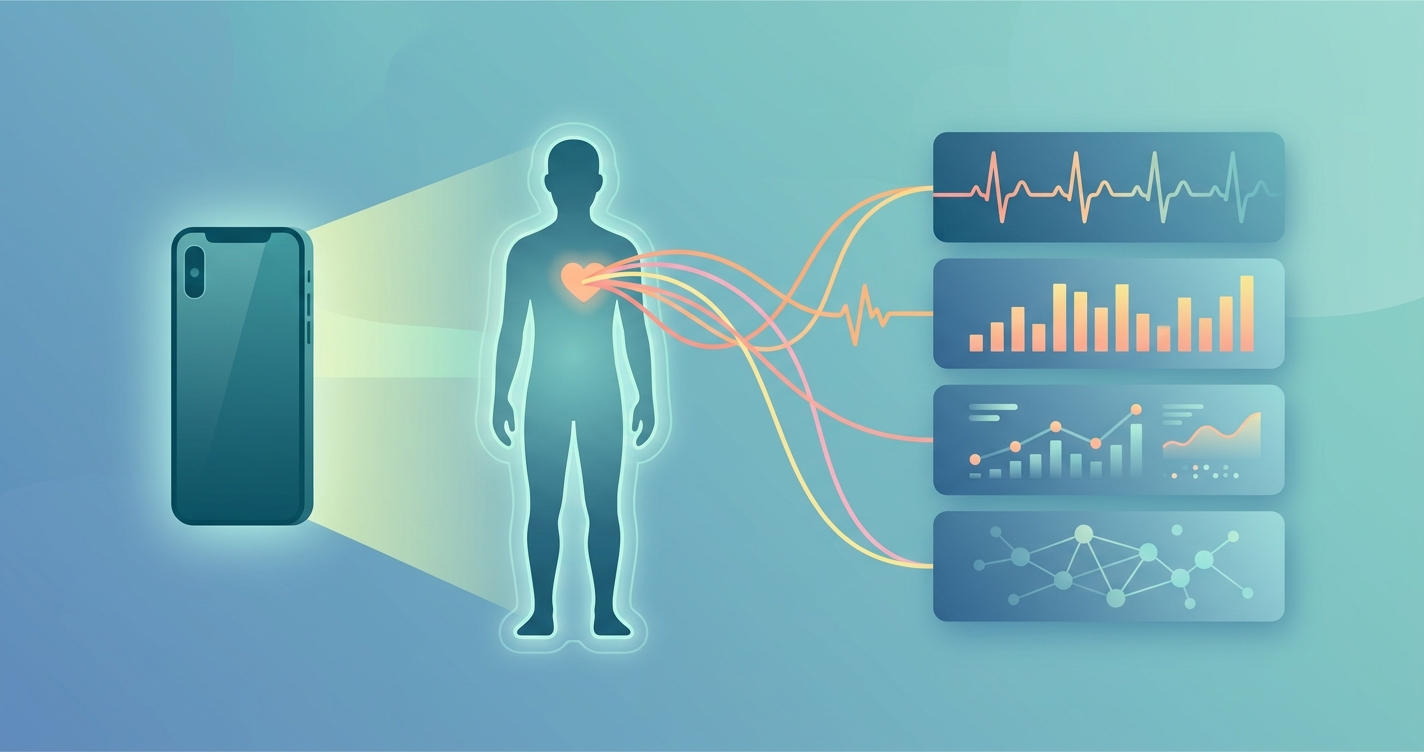
When an applicant submits a life insurance application from a phone and receives a decision before lunch, it can feel like the carrier guessed. It did not. Behind that experience sits a stack of data sources that reconstruct a person's health history without anyone drawing blood or knocking on a door. A health scan for insurance, paired with prescription histories, medical databases, and increasingly real biometric capture, now does much of the work a paramedical exam used to do. For chief underwriting officers and reinsurers weighing how far to push underwriting automation health data, the relevant question is not whether this works but how much signal each source actually carries and where the gaps remain.
An average accelerated underwriting program can expect mortality slippage in the range of 10 to 15 percent relative to traditionally underwritten business, based on industry data through year-end 2023, according to the Society of Actuaries.
That slippage figure is the whole debate in one number. It is the price carriers pay for speed, and the entire engineering effort of modern underwriting is aimed at shrinking it.
What a health scan for insurance actually measures
The phrase "no physical" hides a lot of activity. When a carrier waives the paramedical exam, it replaces the blood panel and the nurse visit with a sequence of digital evidence pulls, sometimes called a digital health waterfall. Each source contributes a piece of the risk picture, and the order in which they are queried is tuned for cost and hit rate.
A health scan for insurance typically draws on several layers. Prescription drug histories from databases such as Milliman IntelliScript and LexisNexis surface seven to ten years of fill records, which is often the single most predictive non-fluid source because medication maps tightly to diagnosed conditions. The Medical Information Bureau returns prior application activity and reported conditions. Electronic health records, when accessible, deliver clinician-recorded diagnoses, lab values, and vitals. Layered on top, smartphone-based biometric capture estimates physiological signals such as resting heart rate, heart rate variability, and blood pressure proxies directly from the applicant, which is the part that most resembles a "scan" to the consumer.
Munich Re's 2024 accelerated underwriting survey found that 59 percent of participating carriers reported using electronic health records in their decisioning, a sharp rise from 2018 levels. The same body of industry research notes that accelerated programs now waive exams for roughly 70 to 85 percent of eligible applicants, typically those under age 60 seeking coverage below 2 to 5 million dollars.
How the sources compare
The value of each input is not equal. Coverage, latency, and predictive lift differ widely, which is why no serious program relies on any single feed.
| Data source | What it reveals | Typical latency | Coverage / limitation |
|---|---|---|---|
| Prescription (Rx) history | Diagnosed and treated conditions via medication | Seconds to minutes | High hit rate; misses undiagnosed or untreated conditions |
| MIB record | Prior applications, previously disclosed conditions | Seconds | Only reflects prior insurance activity |
| Electronic health records | Clinician diagnoses, labs, recorded vitals | Minutes to days | Strong signal where available; access remains uneven |
| Smartphone biometric scan | Live physiological signals (HR, HRV, BP proxy) | Seconds | Captures current state; estimation methods still maturing |
| Application + questionnaire | Self-reported history and behavior | Immediate | Cheapest but prone to nondisclosure |
| Public and behavioral data | Driving records, credit-based scores | Seconds | Indirect proxies for mortality, not clinical |
The pattern that emerges from this table is the core argument for combining sources. Questionnaires are cheap but soft. Rx and MIB are fast and reliable but backward-looking. Biometric capture is the only layer that reflects an applicant's current physiological state rather than a historical paper trail, which is precisely why carriers pursuing fluidless underwriting solutions treat it as complementary to records rather than a substitute.
Why this saves the applicant time
From the buyer's chair, the time savings are obvious. The mechanics behind them are worth spelling out for anyone modeling process economics.
- Records-based sources return in seconds to minutes, compressing what used to be a three to four week paramedical and APS cycle into 24 to 48 hours.
- Parallel querying means multiple feeds resolve at once rather than in sequence, so the applicant is not waiting on a single bottleneck.
- Straight-through processing rules let clean cases bind without human review, reserving underwriters for genuinely ambiguous files.
- Self-captured biometrics remove scheduling friction entirely, since there is no nurse visit to coordinate.
The result is a process that feels instant to the consumer while still resting on auditable evidence the carrier can defend to a reinsurer.
Industry applications for carriers and reinsurers
Accelerated and instant-issue programs
The most direct application is the accelerated path itself. Carriers use the waterfall to triage applicants into accelerate, refer, or full-underwriting buckets. The economics depend on the accelerate rate: too low and the technology investment does not pay back, too high and mortality slippage erodes the block. This is the eligibility threshold problem, and biometric data adds a lever for tightening it without shrinking the accelerated pool.
Reinsurance treaty design
Reinsurers underwrite the program, not just the policy. When a cedent relies on underwriting automation health data, the reinsurer's first question is data provenance and quality. The audit shifts from individual files to the integrity of the data pipeline, the model governance behind any predictive scoring, and the monitoring program that detects drift. Biometric capture introduces a new data lineage question that treaty terms increasingly address explicitly.
Pricing and actuarial calibration
Pricing actuaries have to translate "we waived fluids" into mortality assumptions. Predictive models built on survival data, as documented in Society of Actuaries research on quantifying mortality risk, let teams estimate relative risk from non-fluid inputs. The calibration is only as good as the experience data feeding it, which is why early monitoring is non-negotiable for newer data types.
Current research and evidence
The evidence base is maturing in two directions at once. On the mortality side, the Society of Actuaries issued a 2023 request for proposal specifically to quantify how AI-supported underwriting affects mortality slippage when fluid testing is waived, signaling that the industry wants harder numbers rather than anecdote. The National Association of Insurance Commissioners has run a Delphi study on emerging underwriting methodologies and their impact on mortality experience, drawing structured expert consensus where direct experience data is still thin.
On the modeling side, work presented at the 2023 International Congress of Actuaries showed machine learning methods such as gradient-boosted trees predicting underwriting decisions with high accuracy from digital inputs, which supports automation of the routine cases while flagging the rest. The Society of Actuaries' predictive modeling research on mortality risk reinforces that statistically credible models can rank relative risk from non-traditional data, provided the training population matches the applied population.
The honest reading of this literature is that records-based fluidless underwriting is well understood, with slippage that is measurable and largely manageable. Real-time biometric capture is newer, and its incremental lift over a strong records waterfall is the open empirical question that the next few cycles of experience studies will answer.
The future of health scans for insurance
Three shifts are likely. First, biometric capture will move from supplementary signal to a scored input as estimation methods accumulate validation experience, narrowing the gap between what a phone can measure and what a lab once did. Second, continuous and point-of-sale data will blur the line between underwriting and in-force monitoring, letting carriers refine assumptions after issue rather than only at application. Third, governance will harden, with regulators and reinsurers demanding explainability for any model that touches a decline. The carriers that win will be the ones that treat the health scan not as a gimmick that removes friction but as a defensible evidence source that holds up under an experience study.
Frequently asked questions
How can an insurer assess my health without a physical?
Carriers assemble a risk picture from prescription histories, the Medical Information Bureau, electronic health records, your application answers, and increasingly a smartphone-based biometric scan. Together these reconstruct much of what a paramedical exam used to confirm, which is why a decision can arrive in a day or two instead of weeks.
Is a health scan for insurance as accurate as a blood test?
For many applicants the combination of records and biometric data ranks risk well enough to support an accurate decision, which is why programs report mortality slippage in the 10 to 15 percent range rather than something catastrophic. Blood panels still capture markers that no current scan replicates, so carriers reserve full underwriting for higher face amounts and ambiguous cases.
Why do insurers waive the exam for some people but not others?
Eligibility usually depends on age, coverage amount, and how clean the digital evidence comes back. Younger applicants seeking moderate coverage with consistent records are the strongest candidates, while large face amounts or conflicting data trigger a referral to full underwriting.
What happens to my biometric data after the application?
Reputable programs treat biometric capture under the same consent and data-governance rules as other underwriting evidence, with defined retention and access controls. Reinsurers increasingly require this lineage to be documented as part of treaty terms.
Circadify is building accelerated underwriting infrastructure that treats real biometric data as a first-class evidence source alongside records, rather than leaning on questionnaires alone. Carriers and reinsurers evaluating where biometric capture fits in their data strategy can review the whitepapers and actuarial data at circadify.com/industries/payers-insurance.